What does the documentation score measure?
It is a self-assessment across nine areas: startup, scope, drawings, approvals, change orders, daily records, file access, budget and timeline updates, and final handoff.
Free Self-Assessment
Rate nine practical areas and receive a 0–100 score, clear category, and improvement priorities. No login and no stored responses.
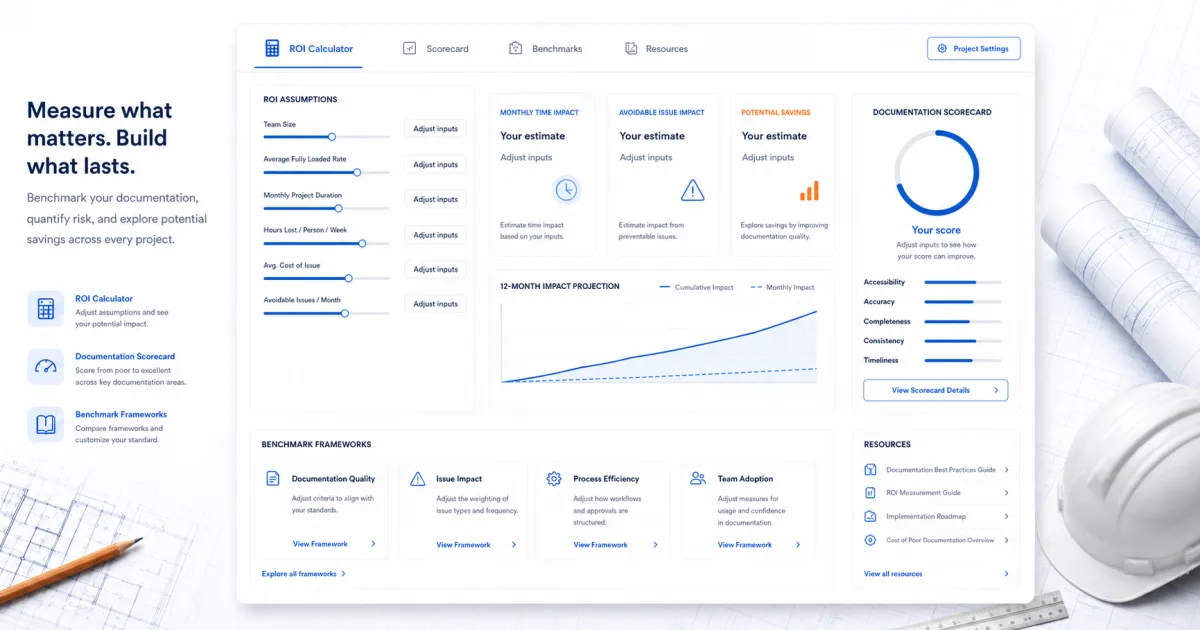
Choose missing, partial, or consistent. The score is a self-assessment framework—not an industry survey benchmark.
Use this at a project closeout review or a quarterly operations check — rate the nine documentation areas honestly to see where your process actually breaks down.
A remodeling contractor scoring 'partial' on change orders and 'missing' on daily records gets a clear signal that those two areas, not the whole system, need fixing first.
Next step
Turn this result into the next thing you actually need.
It is a self-assessment across nine areas: startup, scope, drawings, approvals, change orders, daily records, file access, budget and timeline updates, and final handoff.
No. It is an editorial framework, not a survey percentile or certification. Use it to identify internal gaps and compare the same process over time.
Each area is rated missing, partial, or consistent with values of zero, one, or two. The total is divided by the maximum possible score and converted to 100.
The appropriate standard depends on project risk, contracts, local requirements, and team capacity. Focus first on critical missing records rather than chasing a perfect number.
Repeat it after process changes and at regular operational reviews, using the same definitions. Quarterly can work for stable teams; active implementations may need monthly review.
No. Consistent documentation can reduce ambiguity and improve evidence, but cannot guarantee project, legal, financial, safety, or permitting outcomes.